You've decided to go to Japan. Congratulations — it's going to be one of the best trips you've ever taken. But right now, you're probably staring at 47 browser tabs, three conflicting Reddit threads, and a growing sense that you're doing this all wrong.
You're not. You just need a framework. This page will give you one.
I've been to Japan five times now, and every trip has taught me the same lesson: the planning is harder than the trip itself. Once you're there, everything works. The trains run on time. The food is incredible everywhere. People are kind. The hard part is just deciding where to start.
So let's start.

01Why planning feels impossible
Japan trip planning has a unique problem: there's too much good information, and none of it agrees.
One blog says you need 14 days minimum. Another says 7 is plenty. Someone on Reddit insists you need to book restaurants 60 days in advance. Your coworker says they just winged it and had the best time ever. A YouTube video tells you the JR Pass is essential. The next one says it's a waste of money.
The reason everyone disagrees is that Japan is genuinely flexible. There is no single "right" way to visit. A budget backpacker sleeping in capsule hotels and a couple staying at luxury ryokans will both have an amazing time — they're just having different amazing times.
On top of the information overload, there's the emotional pressure. For most people, Japan is a once-in-a-lifetime trip (at least, that's what you think before you go — most people start planning their second trip before they leave). That "once in a lifetime" feeling makes you want to optimize every single day, which is exactly what makes the planning spiral out of control.
Here's the good news: a simple framework solves about 90% of the confusion. You don't need to research for months. You need to make five decisions, in the right order, and then stop overthinking.
02The 5-step framework
This is the order I recommend for planning any Japan trip. Each step narrows down the next one, so you're never making decisions in a vacuum. Follow these in order and you'll have a solid trip plan within an afternoon.
Step 1: Decide your dates (how many nights?)
Before you pick cities, routes, or activities, figure out how many days you actually have. This single number determines almost everything else about your trip.
Here's what each range looks like in practice:
Don't have a fixed number yet? If you're still debating with your travel partner or trying to figure out how much time you can take off work, our Trip Days Planner can help you land on a number.
Answer a few quick questions and get a recommended trip length for your priorities.
Open Trip Days Planner →If you can swing it, go for 10 days. It's the length where you stop watching the clock and start actually enjoying yourself. Seven days works, but you'll wish you had more. Fourteen is luxurious but not everyone can take that much time off.
Step 2: Pick 2-3 base cities
"Base city" means a place where you'll sleep for multiple nights and take day trips from. This is better than changing hotels every night, which eats up half your morning packing, checking out, navigating to a new station, and finding your next hotel.
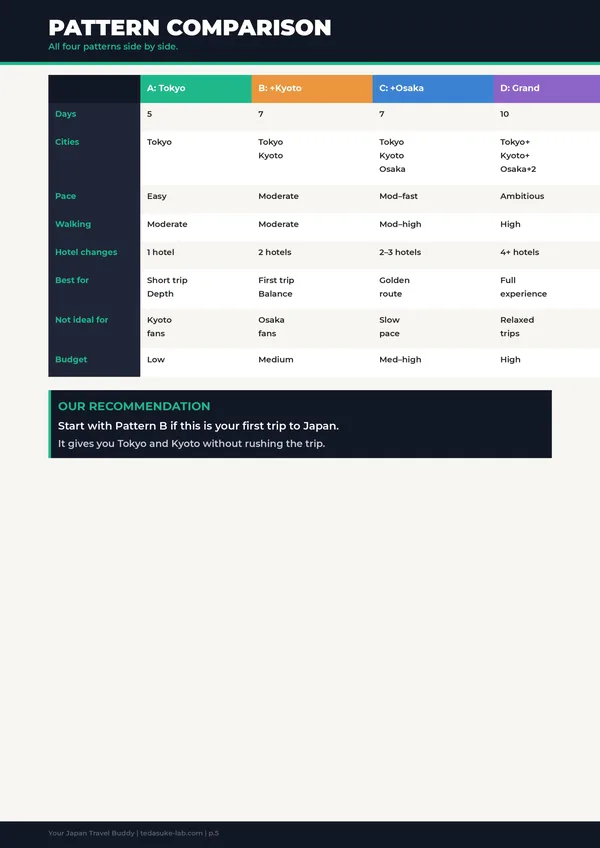
Here's a simple formula based on your trip length:
If Osaka is on your list, USJ is worth a full day — especially the Super Nintendo World area. Pre-book from $55-75 and skip the gate queue.
Check price on KKday →Notice I said "2-3 base cities," not "5-7 cities." One of the biggest mistakes first-timers make is trying to see everything. You can't, and you don't need to. Japan rewards depth, not breadth. Spending three days in Kyoto and actually exploring neighborhoods is better than spending one night each in five different cities.
Step 3: Add day trips from each base
Once you know your base cities, adding day trips is the fun part. Japan's train network is so efficient that you can visit a completely different city and be back for dinner.
From Tokyo, the best day trips for first-timers are Kamakura (temples + beach), Hakone (hot springs + Mt. Fuji views), Nikko (stunning shrines), and Yokohama (Chinatown + harbor). Each takes about 1-1.5 hours by train.
From Kyoto, you can easily day-trip to Nara (friendly deer + massive Buddha), Osaka (food capital), or Himeji (Japan's most beautiful castle).
From Osaka, try Nara if you haven't already, or head to Kobe for a half-day of beef and harbor views.
Not sure which day trips match your interests? Our Day Trip Finder quiz can help narrow it down.
Take the quiz and get personalized recommendations based on what you enjoy.
Take the Day Trip Quiz →We also have a detailed guide covering the 5 best day trips from Tokyo for first-time visitors, with cost breakdowns, routes, and timing for each one.
Don't plan a day trip for every single day. Leave at least one or two "free" days per base city for wandering, unexpected discoveries, and rest. Some of the best moments in Japan happen when you have no plan at all.
Step 4: Estimate your budget
Japan has a reputation for being expensive, and it can be — but it doesn't have to be. The daily cost depends almost entirely on where you sleep and how you eat. Transport and activities are surprisingly affordable.
Here are rough daily budget ranges per person (including accommodation, food, transport, and activities):
A few things that catch people off guard: tipping doesn't exist in Japan (yes, really — don't do it), convenience store food is genuinely delicious (not a compromise), and most temples and shrines are either free or under ¥500 to enter. The expensive parts are usually Shinkansen tickets and hotels during peak season.
For a more detailed breakdown based on your specific trip length and style, try our Budget Estimator.
Get a personalized daily and total budget estimate based on your travel style.
Open Budget Estimator →Step 5: Book flights and hotels
This is where planning turns into commitment, and it's the step most people procrastinate on the longest. Don't be one of those people. Here's why: flight and hotel prices generally increase as you get closer to your dates, especially during peak seasons.
The two peak seasons for Japan travel are:
- Cherry blossom season (late March – mid April): The most popular time to visit. Hotels in Kyoto can sell out 3-4 months in advance. Flights get expensive fast.
- Autumn colors (late October – November): Almost as popular as cherry blossom season but with slightly more availability. Still, book early.
For other times of year, booking 2-3 months ahead is usually fine. For peak season, aim for 4-6 months.
Hotel strategy: Book hotels with free cancellation whenever possible. This lets you lock in a rate now and adjust later if your plans change. Most booking platforms offer this. Our Japan hotel guide breaks down the different accommodation types — from business hotels to ryokans — and when each one makes sense.
Flight tips: Direct flights are worth the extra cost if you can find them. A 12-hour direct flight is dramatically less tiring than a 20-hour trip with a layover. Tokyo has two airports (Narita and Haneda) — Haneda is closer to the city center and generally more convenient.
The best time to book is right after you've decided your dates and base cities. Don't wait for the "perfect" deal — a good-enough booking with free cancellation beats months of price-watching.
03The "good enough" principle
I need to say something that goes against every travel planning instinct you have: your itinerary does not need to be perfect.
I know this is hard to hear. You've been reading blogs, watching videos, comparing routes, and agonizing over whether to visit Fushimi Inari at sunrise or sunset. You've spent more hours planning than you will on the actual Shinkansen.
Here's what I've learned after five trips to Japan: the difference between a "perfect" itinerary and a "good" itinerary is one temple visit. That's it. Maybe you'll miss one garden that would have been lovely. Maybe you'll eat at the second-best ramen shop in the neighborhood instead of the first-best. You genuinely will not notice the difference.
What you will notice is the things no itinerary can plan for. The tiny shrine you stumble into while lost in Kyoto. The izakaya where the owner speaks no English but insists on giving you free edamame. The street in Akihabara that looks nothing like the photos. The moment you realize the convenience store onigiri you're eating for breakfast is better than most restaurant meals back home.
Japan is absurdly good at rewarding spontaneity. The infrastructure is so reliable that you can change plans on the fly without any consequences. Missed your train? Another one comes in 8 minutes. Didn't book that restaurant? Walk into any place with a food display case out front and you'll eat well.
The worst plan is the one you never start. A "good enough" plan that gets you on the plane is infinitely better than a "perfect" plan that lives in a spreadsheet for two more months.
So make your five decisions, book what needs booking, and go. You can figure out the rest when you're there.
04What to book early (and what can wait)
Not everything needs to be decided before you leave. Here's a practical split between what deserves advance booking and what you can sort out once you're in Japan.
Book early
- Flights: Always. Prices generally go up. Set a fare alert if you want, but don't wait more than a few weeks.
- Hotels: Especially for cherry blossom and autumn seasons. Use free cancellation to lock in rates. Kyoto books out the fastest.
- JR Pass (if you need one): The Japan Rail Pass can save money if you're taking multiple Shinkansen trips. But it's not always worth it — check our JR Pass guide to see if it makes sense for your route.
- High-end restaurants: If you want specific omakase sushi or kaiseki spots, some open reservations exactly 30 or 60 days ahead. Regular restaurants don't need advance booking.
Can wait until you're closer (or even in Japan)
- Day trip details: You'll figure out which temples you want to see once you know what the weather looks like that week.
- Restaurant reservations (regular): Most mid-range restaurants don't take reservations. Just show up.
- Specific activities: Things like teamLab, cooking classes, or guided tours can usually be booked a week or two in advance.
- Shopping plans: Don't make a shopping list at home. Wait until you see what's actually available and what catches your eye.
One of the most popular hands-on experiences for first-timers. Learn to make nigiri from a local chef, then eat everything you made ($47-68). Book a few days ahead.
Check price on KKday →One thing you should definitely sort out before your flight: your eSIM. You want mobile data the moment you land for maps, translations, and train schedules. Setting it up at home takes five minutes and saves you from scrambling at the airport.
Our eSIM guide for Japan compares the best options and walks you through setup.
If losing your spot would ruin your trip, book it now. If you could easily find an alternative, it can wait. Most things in Japan fall into the "can wait" category.
05Common first-timer mistakes
I've made most of these myself. Save yourself the learning curve.
Packing too many cities into too few days
This is the number one mistake. Six cities in seven days sounds ambitious and exciting on a spreadsheet. In reality, it means you spend half your trip on trains and the other half checking in and out of hotels. Two or three base cities is enough for any trip under two weeks.
If you're unsure whether your itinerary is too packed, a good rule of thumb: if you have fewer than two full days in any city, you probably have too many cities. Use our Trip Days Planner to sanity-check your schedule.
Not budgeting enough for food
This is the opposite of a problem, and I mean that. Food is one of the highlights of any Japan trip, not an expense to minimize. Budget travelers sometimes plan to eat only convenience store meals, which is fine occasionally, but you'd be missing out on one of the country's greatest strengths.
A solid lunch at a local ramen shop or tonkatsu place costs ¥800-1,200. A sushi set lunch at a quality restaurant runs ¥1,500-2,500. These aren't tourist trap prices — they're what locals pay. Japan is one of the few countries where the "average" restaurant is genuinely excellent.
Budget at least ¥3,000-5,000 per day for food, even as a budget traveler. You won't regret a single yen of it.
Forgetting about travel insurance
Japan's healthcare is excellent but expensive for foreign visitors. A hospital visit for something minor can easily cost tens of thousands of yen without insurance. If you need surgery or an ambulance, you're looking at bills in the hundreds of thousands of yen.
Travel insurance typically costs $30-80 for a two-week trip and covers medical emergencies, trip cancellation, and lost luggage. There's no rational reason to skip it. Check our Japan travel insurance guide for recommendations.
Skipping IC cards
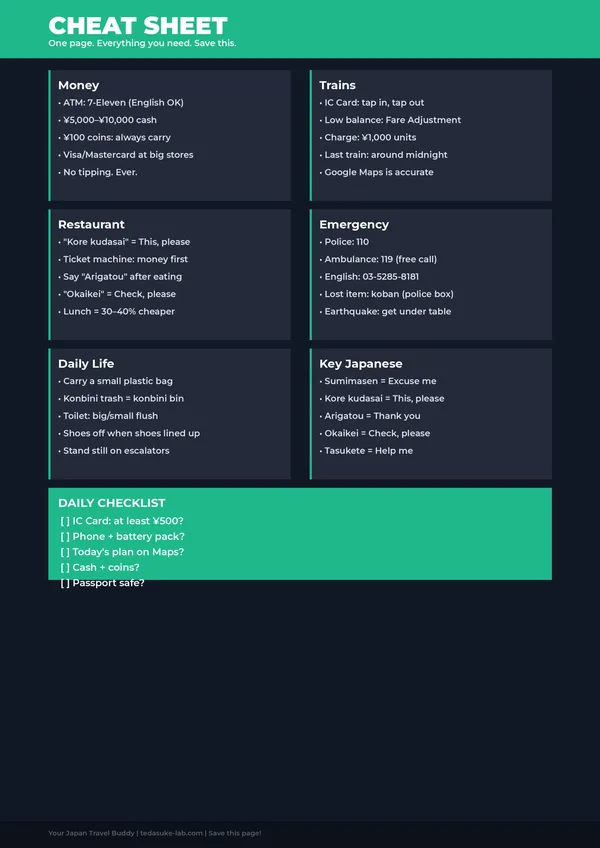
An IC card (Suica or Pasmo) is a rechargeable transit card that works on most trains, buses, and subways in major cities across Japan. You can also use it to pay at convenience stores, vending machines, and some restaurants. It's the single most useful thing you'll carry.
You can get a physical card at the airport or most major train stations. iPhone users can set up a digital Suica in the Wallet app. Either way, do it on day one. Fumbling with cash and ticket machines when you could just tap and go is an unnecessary headache.
Not sure which card to get? Read our Suica vs Pasmo comparison. (Short answer: it doesn't really matter — they work the same way almost everywhere.)
Over-relying on the JR Pass
The Japan Rail Pass is a flat-rate pass for unlimited travel on JR lines, including most Shinkansen routes. It used to be a no-brainer for every visitor, but prices went up significantly in 2023, and now it's only worth it for specific itineraries.
If you're doing a Tokyo-Kyoto-Osaka route with a couple of day trips, the JR Pass might save you money. If you're mostly staying in one city, it almost certainly won't. Do the math before you buy. Our JR Pass guide has a simple calculator.
Spending so long planning that you never actually book. Analysis paralysis is real. Make your five decisions, book the essentials, and trust that Japan will take care of the rest. It always does.
06Your next step
You've read the framework. You know the five steps. You know what to book early and what can wait. Now it's time to actually start.
Here's what I'd do right now, in this order:
- Open the Trip Days Planner and figure out how many days you need. This takes about two minutes and gives you a concrete starting point.
- Pick your base cities using the formula above (7 days = 2 cities, 10 days = 3 cities, 14 days = 3-4 cities).
- Run the Budget Estimator to see roughly what you're looking at cost-wise.
- Book your flights. This is the point of no return, and that's a good thing.
- Book hotels with free cancellation. You can always adjust later.
Everything else — day trips, restaurants, specific activities — can happen later. The five steps above are enough to go from "I want to visit Japan" to "I'm going to Japan."
And honestly? That's the hard part. Once you've booked, the excitement takes over and the planning stops feeling like work.
See you in Japan.
The Trip Days Planner takes 2 minutes and gives you a starting point for everything else.
Open Trip Days Planner →Want the exact routes and maps?
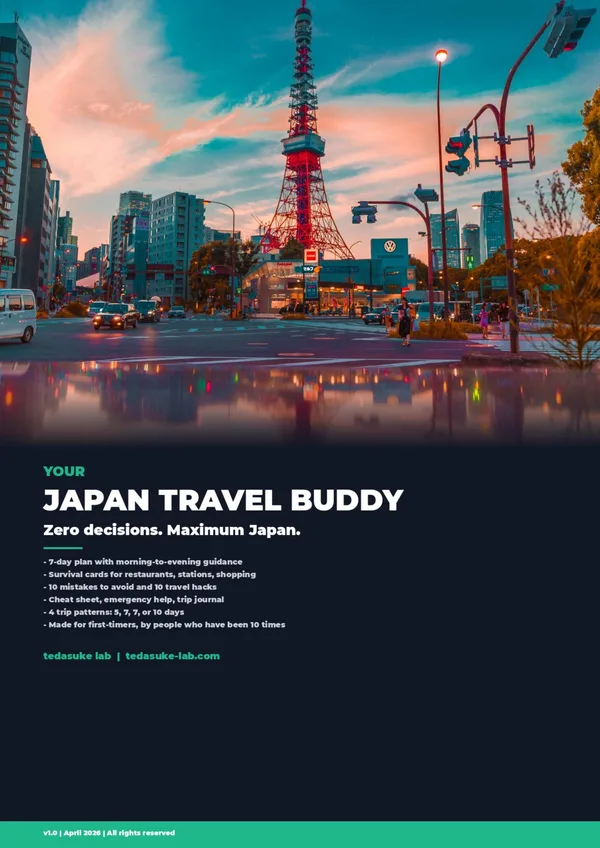
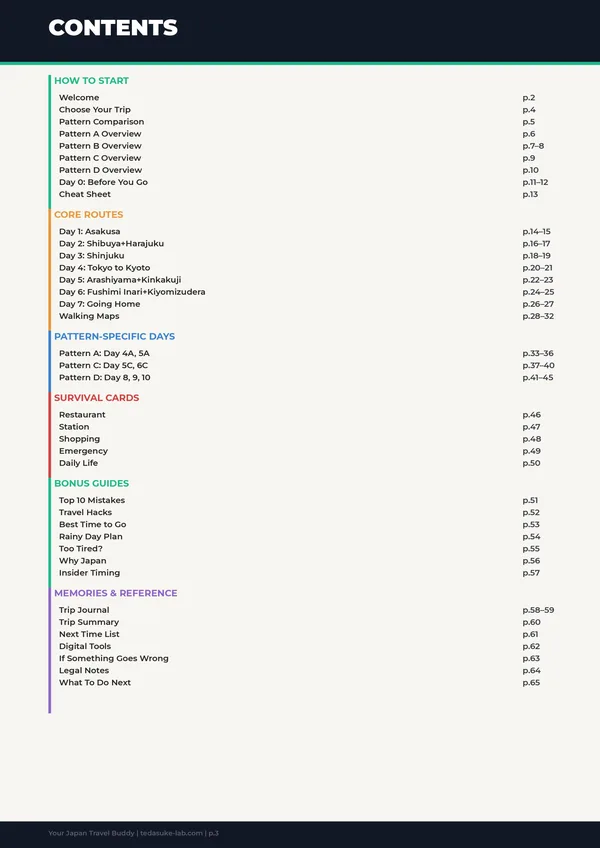
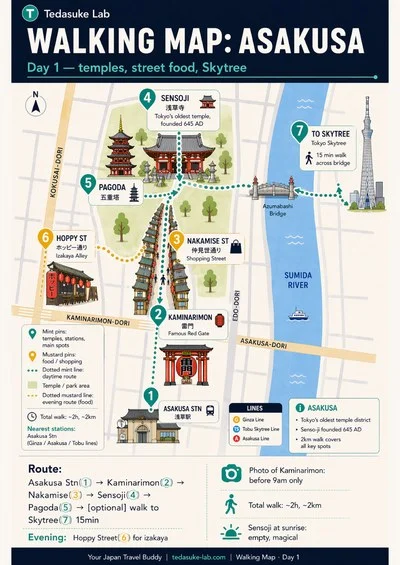
Plan your trip with illustrated walking maps and ready-to-follow routes.
See the complete guide →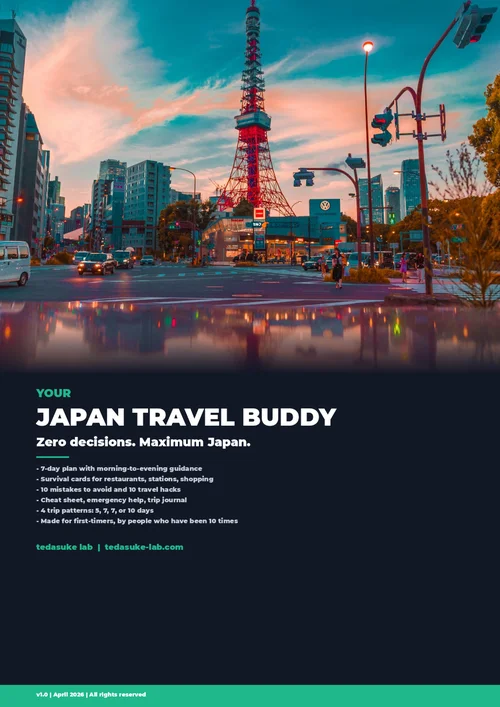
One-time payment · Instant download · Free updates forever